
IDOR Vulnerability: Understanding and Preventing Unauthorized Access
Introduction
Modern web applications handle a huge amount of user data every second — from personal profiles to confidential business information. But when proper access control isn’t implemented, even a small mistake in code can open the door for attackers. One of the most common and overlooked flaws that causes this is the Insecure Direct Object Reference (IDOR) vulnerability.
IDOR attacks are simple to perform yet can have severe consequences. They allow an attacker to access or manipulate data that should only be visible to authorized users. Let’s explore how this vulnerability works, why it’s dangerous, and how developers can prevent it.
What Is an IDOR Vulnerability?
IDOR occurs when an application uses a user-supplied identifier (like an ID, file name, or key) to access internal objects directly without verifying permissions. In simpler terms, it means the system trusts the user’s request without checking whether they are allowed to see or modify the data.
Example
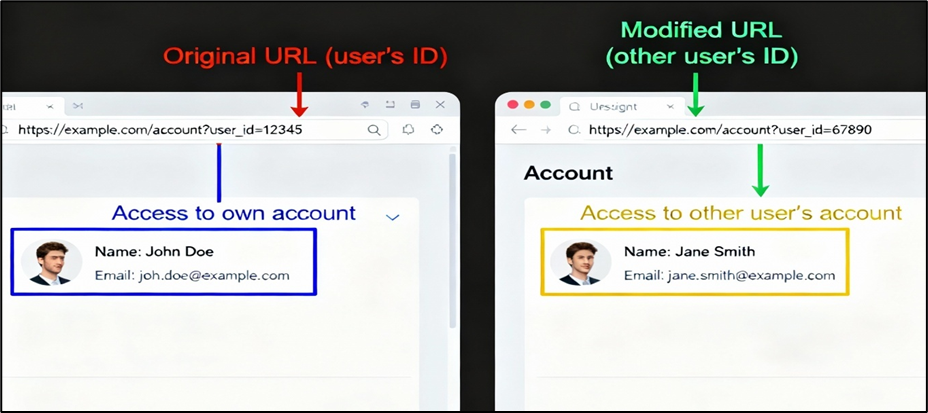
Imagine a website that loads a user’s account details using this URL:
https://example.com/account?id=123
If the system doesn’t verify who is logged in, changing the ID value to another number (like 124) might reveal another user’s account details. This happens because the server fails to confirm that the requester owns or has permission to access that data.
Why IDOR Is a Serious Security Issue
IDOR vulnerabilities might seem harmless, but they can lead to major security breaches. Here’s why they’re dangerous:
Unauthorized data exposure: Attackers can read other users’ private information.
Data modification: They may alter, delete, or replace records belonging to others.
Privilege escalation: Changing parameters could give attackers admin-level access.
Regulatory impact: Exposing sensitive information can violate privacy laws like GDPR or HIPAA.
In short, IDOR can compromise confidentiality, integrity, and compliance — the three pillars of cybersecurity.
How Attackers Exploit IDOR
Attackers often look for predictable or sequential identifiers in URLs, API calls, or form data. They use tools such as Burp Suite, OWASP ZAP, or Postman to intercept and modify requests.
If a request parameter directly maps to an internal object (like a database record), and the system doesn’t validate the user’s authorization, it’s a sign of a potential IDOR weakness.
Common exploitation methods include:
- Changing user IDs in URLs
- Manipulating order or file IDs in APIs
- Modifying session-related tokens
- Enumerating predictable IDs to harvest data
How to Prevent IDOR Vulnerabilities
1. Implement Strong Access Controls
Always verify on the server side whether the user has permission to access or modify the requested resource. Never rely only on client-side checks or hidden form fields.
2. Avoid Direct References
Don’t expose database IDs or object keys directly in requests. Instead, use indirect identifiers such as random tokens, hashed values, or UUIDs that are hard to guess.
3. Adopt Role-Based Access Control (RBAC)
Assign users specific roles and permissions so that each user can access only what they’re authorized to.
4. Perform Security Testing Regularly
Include access control testing as part of your security assessment and penetration testing cycles. Tools like Burp Suite and OWASP ZAP can help detect possible IDOR endpoints.
5. Follow Secure Coding Guidelines
Train developers to understand authorization logic and to validate permissions at every point where data is requested or modified.
Conclusion
Insecure Direct Object Reference (IDOR) is a simple but powerful vulnerability that can expose critical information or allow attackers to manipulate system data. The best defence is to design applications with security in mind — enforcing authorization checks, using indirect identifiers, and testing regularly for access control flaws.
A secure system is not just about authentication — it’s about ensuring every user can only access what they are truly allowed to.
By taking these preventive steps, organizations can strengthen their applications against IDOR and maintain the trust of their users.
👉 Get in touch with Pynesec to secure your codebase and stay ahead of cyber threats.
📈 Stay Secure. Stay Ahead. Choose Pynesec.